- Posts: 1970
- Thank you received: 609
The 'Introduce yourself' Thread
- David Thompson
-

- Offline
- Platinum Member
-

Less
More
18 Oct 2012 12:18 #3531
by David Thompson
Youth is wasted on the young !
Replied by David Thompson on topic The 'Introduce yourself' Thread
I think they might be American Army units rather than British Army ones ?
If you Google 'mobile reclamation and repair' you will find a link to a download from the website of the D-Day Museum , www.ddaymuseum.co.uk . Scroll down the list and there are 'undreds of various units including MR&R ones .
Good luck !
Have just read post#2 ; they are American units !
If you Google 'mobile reclamation and repair' you will find a link to a download from the website of the D-Day Museum , www.ddaymuseum.co.uk . Scroll down the list and there are 'undreds of various units including MR&R ones .
Good luck !
Have just read post#2 ; they are American units !
Youth is wasted on the young !
Please Log in or Create an account to join the conversation.
- chrislynnpifer
- Offline
- New Member
-

Less
More
- Posts: 5
- Thank you received: 0
18 Oct 2012 16:05 #3532
by chrislynnpifer
Replied by chrislynnpifer on topic The 'Introduce yourself' Thread
Thank YOU! I will look into that. I appreciate you!
Please Log in or Create an account to join the conversation.
- MikeO
- Offline
- Senior Member
-

Less
More
- Posts: 176
- Thank you received: 14
18 Oct 2012 20:20 #3533
by MikeO
Replied by MikeO on topic The 'Introduce yourself' Thread
The 32nd Mobile Repair and Reclamation Squadron was a unit of the USAAF 9th Air Force. It was activated at Matching, Essex on 23 Nov 1943 was at a number of other English airfields before moving to France in July 1944 and arrived in Germany in March 1944 - eventually de-activating at Muchen Gladbach 23 May 1944. The story about dismantling ME 262 rings true. Many captured Luftwaffe aircraft were dismantled and taken to the USA.
Your father's records should be at the NARA and this link may be helpful www.military.com/benefits/records-and-fo...rsonnel-records.html
Good luck!
Your father's records should be at the NARA and this link may be helpful www.military.com/benefits/records-and-fo...rsonnel-records.html
Good luck!
Please Log in or Create an account to join the conversation.
- MikeO
- Offline
- Senior Member
-
Less
More
- Posts: 176
- Thank you received: 14
18 Oct 2012 20:23 #3534
by MikeO
Replied by MikeO on topic The 'Introduce yourself' Thread
Whoops. Should have had brain engaged before copying those dates in Germany. They should both say 1945 not 1944
Please Log in or Create an account to join the conversation.
- airfields man
-

- Offline
- Platinum Member
-
Less
More
- Posts: 5383
- Thank you received: 603
18 Oct 2012 20:51 #3535
by airfields man
The Dead got memorials, The living got time.
Replied by airfields man on topic The 'Introduce yourself' Thread
Having just read your above post I was about to say something similar to your quote. But you are partly right about the USAAF being in Germany in march 1944. It was the first daylight raid on Berlin. 06-03-44.Whoops. Should have had brain engaged before copying those dates in Germany. They should both say 1945 not 1944
The Dead got memorials, The living got time.
Please Log in or Create an account to join the conversation.
- chrislynnpifer
- Offline
- New Member
-
Less
More
- Posts: 5
- Thank you received: 0
19 Oct 2012 00:27 #3536
by chrislynnpifer
Replied by chrislynnpifer on topic The 'Introduce yourself' Thread
My Dad wrote of arriving in '42 on the Capetown Castle landing in Liverpool, trucking to Manchester. Apparently he had multiple orders and a difficult time finding his unit. the unit, when he finally found them consisted of A Captain, First Sgt, and himself. He said it took almost 2 weeks before they finally got the rest of their group and moved out. He mentioned several people by name, which I need to find notes on. I recall that when he ws in Germany, he said they called themselves the "Lost Squadron" because they were camped in the Black Forest for several weeks without being resupplied and hearing from no one. I hate to thik how many other units must have found themselves in similar circumstances.
Ever so often I find little notes he wrote or told me, but I just find them as I search thru his belongings.
I appreciate all the little hints, and will definitely check out the site you mentioned.
The St. Louis fire certainly made gathering information a challenge!
Thank you all!
Ever so often I find little notes he wrote or told me, but I just find them as I search thru his belongings.
I appreciate all the little hints, and will definitely check out the site you mentioned.
The St. Louis fire certainly made gathering information a challenge!
Thank you all!
Please Log in or Create an account to join the conversation.
- jgd brown
- Offline
- New Member
-
Less
More
- Posts: 1
- Thank you received: 0
20 Oct 2012 22:51 #3537
by jgd brown
Replied by jgd brown on topic The 'Introduce yourself' Thread
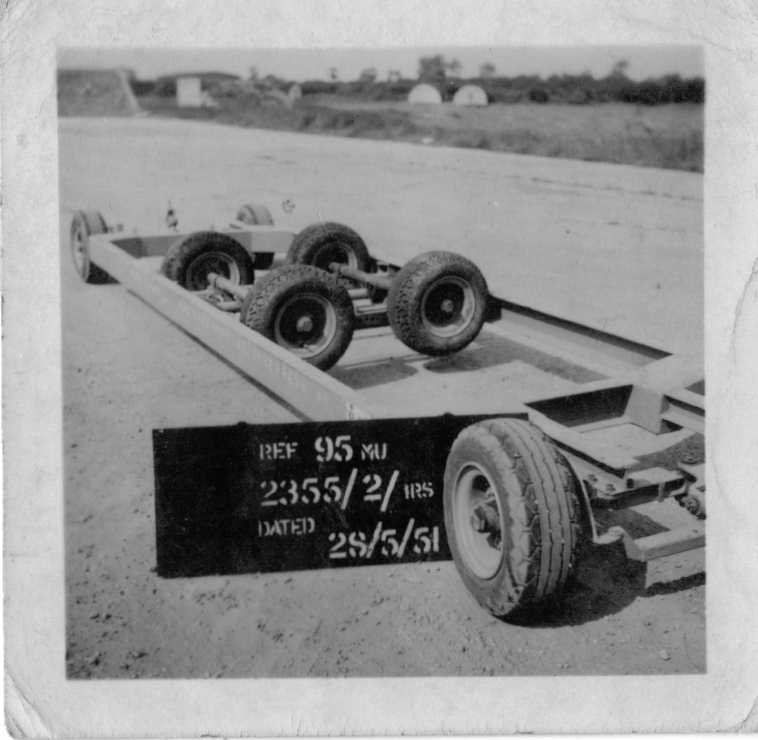
thought you may be interested in a photograph of an invention for which my father won the first award for the RAF in safer handling of bombs The invention had the label 95mu 2355/2/1rs date 28/5/51 shown on it.
It was for painting the coloured bands around the bombs using two football pitch markers for each stripe...on his prototype
my father was the late flight sergeant george d.brown.
Attached files
This image is hidden for guests.
It was for painting the coloured bands around the bombs using two football pitch markers for each stripe...on his prototype
my father was the late flight sergeant george d.brown.
Attached files
This image is hidden for guests.
Please log in or register to see it.
Please Log in or Create an account to join the conversation.
- PETERTHEEATER
-

- Offline
- Platinum Member
-
Less
More
- Posts: 10905
- Thank you received: 772
21 Oct 2012 04:10 #3538
by PETERTHEEATER
Replied by PETERTHEEATER on topic The 'Introduce yourself' Thread
Welcome to AiX jgd brown and thanks for the interesting photograph.
95 M.U. (Maintenance Unit) were based at Ridgewell (post-war!). The MU also had a sub-site at Nuthampstead. They would have been inspecting and refurbishing aircraft bombs. His invention appears to be a rig made from bomb trolley wheels and axles onto which a cylindrical bomb could be lowered and then rotated whilst the paint striping machine was applied to produce a uniform width line around the bomb. For example, a red line near the nose of the bomb indicated that the filling was HE (High explosive).
The centre between the wheels does not appear to be adjustable and the rig may have been used for one specific bomb type the cylindrical HC (High Capacity) bomb that came in various weights from 2000 pound up to 12000 pound.
The rig is mounted on a Type C Bomb Trolley.
I was part of the RAF Bomb Disposal Flight from Debden that carried out the clearance of the Ridgewell bomb store in 1965.
The Ridgewell bomb store was here:
wtp2.appspot.com/wheresthepath.htm?lat=5...5318&gz=15&oz=8>=1
and the Nuthampstead bomb store was here:
wtp2.appspot.com/wheresthepath.htm?lat=5...5318&gz=15&oz=8>=1
The photograph appears to be Ridgewell south section of the bomb store.
WW2 RAF surplus bombs were stored in spaced stacks on the runways and maintenance and inspection carried out in the former bomb store usually the Fuzing Point sheds.
A 4000 pound HC bomb diagram:
This image is hidden for guests.
95 M.U. (Maintenance Unit) were based at Ridgewell (post-war!). The MU also had a sub-site at Nuthampstead. They would have been inspecting and refurbishing aircraft bombs. His invention appears to be a rig made from bomb trolley wheels and axles onto which a cylindrical bomb could be lowered and then rotated whilst the paint striping machine was applied to produce a uniform width line around the bomb. For example, a red line near the nose of the bomb indicated that the filling was HE (High explosive).
The centre between the wheels does not appear to be adjustable and the rig may have been used for one specific bomb type the cylindrical HC (High Capacity) bomb that came in various weights from 2000 pound up to 12000 pound.
The rig is mounted on a Type C Bomb Trolley.
I was part of the RAF Bomb Disposal Flight from Debden that carried out the clearance of the Ridgewell bomb store in 1965.
The Ridgewell bomb store was here:
wtp2.appspot.com/wheresthepath.htm?lat=5...5318&gz=15&oz=8>=1
and the Nuthampstead bomb store was here:
wtp2.appspot.com/wheresthepath.htm?lat=5...5318&gz=15&oz=8>=1
The photograph appears to be Ridgewell south section of the bomb store.
WW2 RAF surplus bombs were stored in spaced stacks on the runways and maintenance and inspection carried out in the former bomb store usually the Fuzing Point sheds.
A 4000 pound HC bomb diagram:
This image is hidden for guests.
Please log in or register to see it.
Please Log in or Create an account to join the conversation.
- downtide
- Offline
- New Member
-
Less
More
- Posts: 2
- Thank you received: 0
21 Oct 2012 09:59 #3539
by downtide
Replied by downtide on topic The 'Introduce yourself' Thread
Hi
I recently bought one of the 200 pre-fab bungalows at Sculthorpe airbase built by the Americans during the Cold War (in Lancaster Road, no less). Although unconventional, with their concrete walls and lightweight internal partitions, these houses show no signs of structural deterioration and are spacious and comfortable. They also offer the added bonus of being very cheap to buy!
I understand they were constructed to a standard US design but using mainly Irish labour and I’d be very interested to learn more about their history.
Any information or photos out there please?
I recently bought one of the 200 pre-fab bungalows at Sculthorpe airbase built by the Americans during the Cold War (in Lancaster Road, no less). Although unconventional, with their concrete walls and lightweight internal partitions, these houses show no signs of structural deterioration and are spacious and comfortable. They also offer the added bonus of being very cheap to buy!
I understand they were constructed to a standard US design but using mainly Irish labour and I’d be very interested to learn more about their history.
Any information or photos out there please?
Please Log in or Create an account to join the conversation.
- Alex Brown
- Offline
- Platinum Member
-
Less
More
- Posts: 2418
- Thank you received: 21
21 Oct 2012 15:04 #3540
by Alex Brown
Presumably being of "Non Standard Construction" they are cheap because it's more difficult to obtain a mortgage?
Yes, I'm back(ish).
Replied by Alex Brown on topic The 'Introduce yourself' Thread
Hi
I recently bought one of the 200 pre-fab bungalows at Sculthorpe airbase built by the Americans during the Cold War (in Lancaster Road, no less). Although unconventional, with their concrete walls and lightweight internal partitions, these houses show no signs of structural deterioration and are spacious and comfortable. They also offer the added bonus of being very cheap to buy!
I understand they were constructed to a standard US design but using mainly Irish labour and I’d be very interested to learn more about their history.
Any information or photos out there please?
Presumably being of "Non Standard Construction" they are cheap because it's more difficult to obtain a mortgage?
Yes, I'm back(ish).
Please Log in or Create an account to join the conversation.
Time to create page: 0.160 seconds