- Posts: 365
- Thank you received: 30
- Forum
- Open Forum
- Miscellaneous Research Topics
- General Airfield or 20th Century Military Architecture Discussion Topics
- RAF 'Y' Stations etc. Discussion Thread
RAF 'Y' Stations etc. Discussion Thread
- HF Dave
-

- Offline
- Senior Member
-

Less
More
05 Jul 2014 13:31 #121
by HF Dave
My understanding is that the HDUs were originally those coastal intercept stations set up specifically as an anti-invasion measure, their purpose being to intercept and interpret R/T (voice) traffic from German planes. They played an important role in the Battle of Britain, supplementing information from radar.
Replied by HF Dave on topic RAF 'Y' Stations etc.
I wonder exactly what an HDU was - possibly an innocuous name rather like the Chain Home stations were known as Air Ministry Experimental Stations?
The Bletchley Park list shows the RAF and Navy having HDUs, the Army, Foreign Office, RSS and Post Office didn't.
From SD161 July 1942:
In 62 Group No.63 Wireless Unit, West Kingsdown controlled the following HDUs:
Beachy Head, Folkestone, Gorleston, Scarborough, Shaftesbury, Simpsons Corner (Ingoldmells), Sittingbourne, Strete, Upton Grey.
Also unable to trace Simpsons Corner at Ingoldmells.
My understanding is that the HDUs were originally those coastal intercept stations set up specifically as an anti-invasion measure, their purpose being to intercept and interpret R/T (voice) traffic from German planes. They played an important role in the Battle of Britain, supplementing information from radar.
Please Log in or Create an account to join the conversation.
- HF Dave
-
- Offline
- Senior Member
-
Less
More
- Posts: 365
- Thank you received: 30
05 Jul 2014 20:52 #122
by HF Dave
The wartime Cassini reference for Ingoldmells HDU seems to be wG024884 which roughly translates to TF 560 696. This places the station just north of Anchor Lane in Ingoldmells. At the time there was a building called Rosary House which perhaps could have been used.
I can only assume that the sharp bend in the main road (A52 Chapel Road) to the south of the site was known as Simpsons Corner. There is a Simpson Court nearby now, so this seems plausible.
Replied by HF Dave on topic RAF 'Y' Stations etc.
Also unable to trace Simpsons Corner at Ingoldmells.
The wartime Cassini reference for Ingoldmells HDU seems to be wG024884 which roughly translates to TF 560 696. This places the station just north of Anchor Lane in Ingoldmells. At the time there was a building called Rosary House which perhaps could have been used.
I can only assume that the sharp bend in the main road (A52 Chapel Road) to the south of the site was known as Simpsons Corner. There is a Simpson Court nearby now, so this seems plausible.
Please Log in or Create an account to join the conversation.
- carnaby
-
 Topic Author
- Offline
- Platinum Member
-

Less
More
- Posts: 5026
- Thank you received: 440
06 Jul 2014 10:00 #123
by carnaby
Plan A is always more effective when the problem you are working on understands that Plan B will involve the use of dynamite
Replied by carnaby on topic RAF 'Y' Stations etc.
Looking through the various TNA copies I have:
In 1942 there were three 'Y' sites at Ingoldmells (Northern Command): G024884 (TF560696), G021884 (557696) and G024888 (560700)
One was described as a 'MF/HF D/F station', another was an 'Air Ministry W/T station'
Another document describes all three as 'Main Intercept Stations'.
All do not feature after 1942.
I have emailed a local school.
In 1942 there were three 'Y' sites at Ingoldmells (Northern Command): G024884 (TF560696), G021884 (557696) and G024888 (560700)
One was described as a 'MF/HF D/F station', another was an 'Air Ministry W/T station'
Another document describes all three as 'Main Intercept Stations'.
All do not feature after 1942.
I have emailed a local school.
Plan A is always more effective when the problem you are working on understands that Plan B will involve the use of dynamite
Please Log in or Create an account to join the conversation.
- Stan Ames
- Offline
- New Member
-

Less
More
- Posts: 19
- Thank you received: 0
07 Jul 2014 17:16 #124
by Stan Ames
Replied by Stan Ames on topic RAF 'Y' Stations etc.
Hi Carnaby
A major site like Ingoldmells could have had HF and MF df stations as well as main intercept. The site is mentioned in "The Enemy is Listening" by Aileen Clayton. This is a very good source of RAF Y information and second hand copies are still available on usedbooksearch. The name "Home Defence Unit" was a cover name for the network of RAF Y stations controlled by Kingsdown and, together with Gorelston and Scarborough, Ingoldmells "monitored 95%" of GAF traffic in 1941. Perhaps some of the HDUs were closed as the local GAF activity decreased??
MF DF stations are very easy to spot and HF df stations less so on the 1945 aerial images and if anyone lives close enough to Lincoln there should be copies in the county archives. Major Universities like Oxford and Cambridge also have full UK collections. English Heritage also have a full collection and will sell you one for about £20!
I have made an enquiry with Lincoln archives and will let you know if I find anything.
Stan
A major site like Ingoldmells could have had HF and MF df stations as well as main intercept. The site is mentioned in "The Enemy is Listening" by Aileen Clayton. This is a very good source of RAF Y information and second hand copies are still available on usedbooksearch. The name "Home Defence Unit" was a cover name for the network of RAF Y stations controlled by Kingsdown and, together with Gorelston and Scarborough, Ingoldmells "monitored 95%" of GAF traffic in 1941. Perhaps some of the HDUs were closed as the local GAF activity decreased??
MF DF stations are very easy to spot and HF df stations less so on the 1945 aerial images and if anyone lives close enough to Lincoln there should be copies in the county archives. Major Universities like Oxford and Cambridge also have full UK collections. English Heritage also have a full collection and will sell you one for about £20!
I have made an enquiry with Lincoln archives and will let you know if I find anything.
Stan
Please Log in or Create an account to join the conversation.
- Stan Ames
- Offline
- New Member
-
Less
More
- Posts: 19
- Thank you received: 0
07 Jul 2014 17:37 #125
by Stan Ames
Replied by Stan Ames on topic RAF 'Y' Stations etc.
Google Earth have just increased their 1940s coverage of aerial images. Kent County Council have provided Google with full coverage of the county dated "1940" and a second set dated "1960". I have found a number of WW2 Y stations and with some searching there should be more. DF stations stand out if you know what to look for here are two RSS df stations at Lydd, one HF and one MF.
dl.dropboxusercontent.com/u/33983550/WW2/Lydd%20MW%20DF.jpg
dl.dropboxusercontent.com/u/33983550/WW2/LyddHF%20DF.jpg
This one is of the Foreign Office diplomatic intercept station at Knockholt that continued after W2 under GCHQ.
dl.dropboxusercontent.com/u/33983550/WW2/LyddHF%20DF.jpg
Doubtless there are more, Kent was a popular area for Y stations
Stan
dl.dropboxusercontent.com/u/33983550/WW2/Lydd%20MW%20DF.jpg
dl.dropboxusercontent.com/u/33983550/WW2/LyddHF%20DF.jpg
This one is of the Foreign Office diplomatic intercept station at Knockholt that continued after W2 under GCHQ.
dl.dropboxusercontent.com/u/33983550/WW2/LyddHF%20DF.jpg
Doubtless there are more, Kent was a popular area for Y stations
Stan
Please Log in or Create an account to join the conversation.
- carnaby
-
Topic Author
- Offline
- Platinum Member
-
Less
More
- Posts: 5026
- Thank you received: 440
07 Jul 2014 18:08 #126
by carnaby
Plan A is always more effective when the problem you are working on understands that Plan B will involve the use of dynamite
Replied by carnaby on topic RAF 'Y' Stations etc.
Great info, Stan. I've ordered a copy of Clayton (all the cheapies are from the USA).
HDUs are mentioned in Kenneth Macksey's The Searchers (forgot I had a copy). It adds RAF HDUs monitored GAF traffic during Dunkirk which helped the evacuation. They also assisted the Navy in monitoring E-boat comms. I guess this explains why HDUs were restricted to the RAF and Navy (not the Army etc) as they were both responsible for Channel activities.
Later they monitored strange Luftwaffe messages which proved to be the beginning of the air-to-ground comms as the Kammhuber defence system began to take shape.
Stirring stuff.
HDUs are mentioned in Kenneth Macksey's The Searchers (forgot I had a copy). It adds RAF HDUs monitored GAF traffic during Dunkirk which helped the evacuation. They also assisted the Navy in monitoring E-boat comms. I guess this explains why HDUs were restricted to the RAF and Navy (not the Army etc) as they were both responsible for Channel activities.
Later they monitored strange Luftwaffe messages which proved to be the beginning of the air-to-ground comms as the Kammhuber defence system began to take shape.
Stirring stuff.
Plan A is always more effective when the problem you are working on understands that Plan B will involve the use of dynamite
Please Log in or Create an account to join the conversation.
- mbriscoe
-

- Offline
- Moderator
-

07 Jul 2014 18:37 #127
by mbriscoe
Alan Peacock describes monitoring E-Boats from destroyers in his book.
The Enigmatic Sailor
Alan Peacock
He trained at RNTE Southmead for the work.
Replied by mbriscoe on topic RAF 'Y' Stations etc.
Great info, Stan. I've ordered a copy of Clayton (all the cheapies are from the USA).
HDUs are mentioned in Kenneth Macksey's The Searchers (forgot I had a copy). It adds RAF HDUs monitored GAF traffic during Dunkirk which helped the evacuation. They also assisted the Navy in monitoring E-boat comms. I guess this explains why HDUs were restricted to the RAF and Navy (not the Army etc) as they were both responsible for Channel activities.
Later they monitored strange Luftwaffe messages which proved to be the beginning of the air-to-ground comms as the Kammhuber defence system began to take shape.
Stirring stuff.
Alan Peacock describes monitoring E-Boats from destroyers in his book.
The Enigmatic Sailor
Alan Peacock
He trained at RNTE Southmead for the work.
Please Log in or Create an account to join the conversation.
- Stan Ames
- Offline
- New Member
-
Less
More
- Posts: 19
- Thank you received: 0
08 Jul 2014 18:47 #128
by Stan Ames
Replied by Stan Ames on topic RAF 'Y' Stations etc.
Carnaby
Yes, Macksey's The Searchers is another good source, it was one of the first books I bought when I started delving into wireless interception. I found some information about GPO St Albans Radio (local) that was doing covert interception even before WW2.
I have just noticed that the last of the image links I provided was wrong, the Knockholt station image can be found at -
dl.dropboxusercontent.com/u/33983550/WW2/Knockholt%20FO.jpg
I have also found the Army MF df station at Sutton Valence
dl.dropboxusercontent.com/u/33983550/WW2...0vallence%20MFDF.jpg
I have received a holding reply from Lincolnshire archives about the aerial images of Ingoldmells, will let you know if anything useful comes of it. There were quite a few on the Lincs. coast.
Martin (Briscoe)
Thanks for the note about "The Enigmatic Sailor".
Yes, Macksey's The Searchers is another good source, it was one of the first books I bought when I started delving into wireless interception. I found some information about GPO St Albans Radio (local) that was doing covert interception even before WW2.
I have just noticed that the last of the image links I provided was wrong, the Knockholt station image can be found at -
dl.dropboxusercontent.com/u/33983550/WW2/Knockholt%20FO.jpg
I have also found the Army MF df station at Sutton Valence
dl.dropboxusercontent.com/u/33983550/WW2...0vallence%20MFDF.jpg
I have received a holding reply from Lincolnshire archives about the aerial images of Ingoldmells, will let you know if anything useful comes of it. There were quite a few on the Lincs. coast.
Martin (Briscoe)
Thanks for the note about "The Enigmatic Sailor".
Please Log in or Create an account to join the conversation.
- Stan Ames
- Offline
- New Member
-
Less
More
- Posts: 19
- Thank you received: 0
12 Jul 2014 14:44 #129
by Stan Ames
Replied by Stan Ames on topic RAF 'Y' Stations etc.
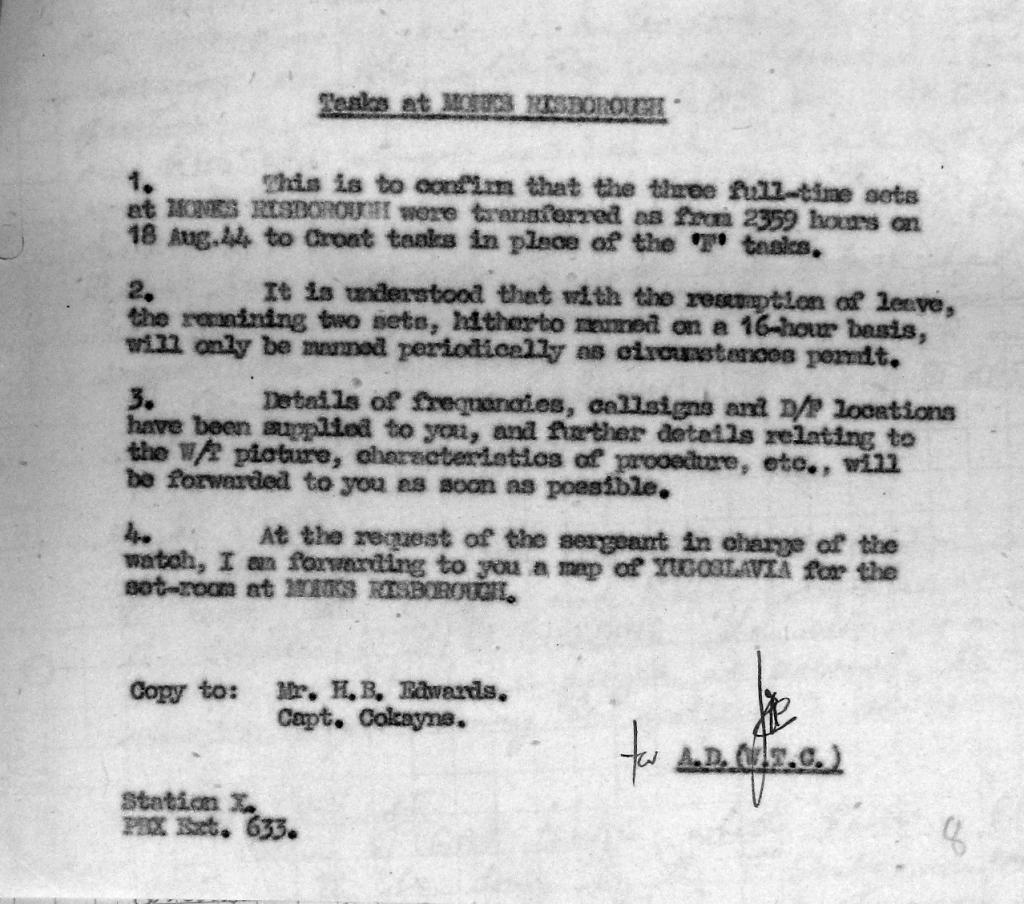
Some time ago there was a discussion here about Monks Risborough Y station. I have just found a document from August 1944 about this station stating that they were transferring their interest to from "F tasks" to "CROAT TANKS". This is not the first time I have seen evidence of Y stations of one service doing work for another service. Any comments from the forum would be welcome.
Stan
This image is hidden for guests.
Stan
This image is hidden for guests.
Please log in or register to see it.
Please Log in or Create an account to join the conversation.
- PETERTHEEATER
-
- Offline
- Platinum Member
-
Less
More
- Posts: 10905
- Thank you received: 772
13 Jul 2014 14:20 #130
by PETERTHEEATER
Replied by PETERTHEEATER on topic RAF 'Y' Stations etc.
You got my brow furrowed there Stan. Croat tanks (sic) should read Croat tasks whatever they were.
Please Log in or Create an account to join the conversation.
- Forum
- Open Forum
- Miscellaneous Research Topics
- General Airfield or 20th Century Military Architecture Discussion Topics
- RAF 'Y' Stations etc. Discussion Thread
Time to create page: 0.059 seconds