- Posts: 4566
- Thank you received: 323
Help with unit identification
- P Bellamy
-

- Offline
- Platinum Member
-

Less
More
29 Oct 2012 00:39 #11
by P Bellamy
Paul Bellamy
Replied by P Bellamy on topic Help with unit identification
All three of the "modern" crash vehicles in the original photo can be seen hiding behind the two film-prop ones in the 633 Sqn screen grab. 
The RAF Fire Services website has the Mk.6 listed as coming into service in 1956. I didn't know about the upgraded monitor coming in later, cheers Ted.
Comparing them to the vehicles list on that website I thought they were (left to right) an ACRT, Mk.6 and a DP1, but post-WWII MT isn't something I'm really up on.
All the best,
PB
The RAF Fire Services website has the Mk.6 listed as coming into service in 1956. I didn't know about the upgraded monitor coming in later, cheers Ted.
Comparing them to the vehicles list on that website I thought they were (left to right) an ACRT, Mk.6 and a DP1, but post-WWII MT isn't something I'm really up on.
All the best,
PB
Paul Bellamy
Please Log in or Create an account to join the conversation.
- ted angus
- Offline
- Platinum Member
-
Less
More
- Posts: 1643
- Thank you received: 51
29 Oct 2012 11:29 #12
by ted angus
Replied by ted angus on topic Help with unit identification
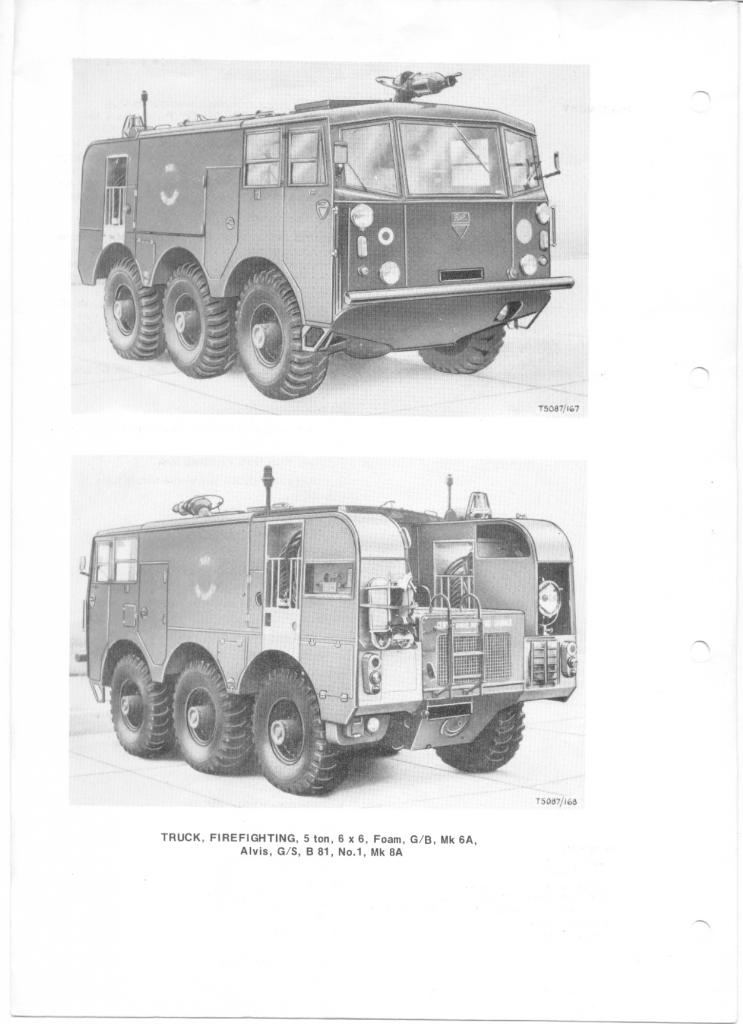
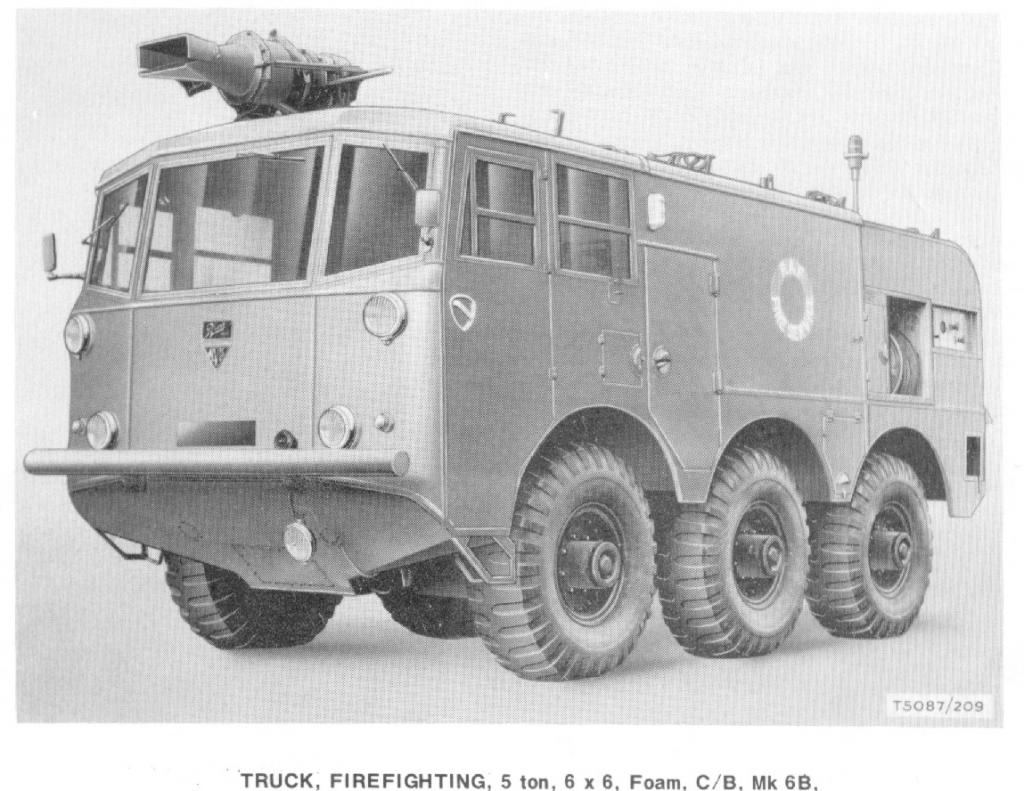
PB yes but there were several versions of the Mk6 which ran over a period of several years. On intro the MK 6 (see data 1 attached ) had a small monitor and a hose reel each side for the secondary media. then came the MK6A (see data 2 attached) same monitor but the hose for the secondary media was stowed figure of 8 style in a cage; Under the bonnet there were lots of differences involving suspension PTOs types of tanks etc etc but I won't confuse the issue. It was decided to upgrade the vehicles with a monitor of double the existing capacity and at the same time a further batch of new build was ordered.
On fitting the larger monitor the MK6 became the MK6B (see data 4 attached ) The MK6A became the MK6D. The new build batch which was identical to the MK6D in 99% of its build was designated MK6C. The Modification leaflet to fit the larger monitor is dated 1963 but the programme actually started earlier.
The Landie of course is the ACRT and the Thorny is the DP 1. Unfortunately even in some of the Air Publications there are glaring errors with captions on photos and the same is creeping into the RAF fire service web site. An enthusiast in Germany has posted some lovely colour photos as being RAF Sydenham in NI but unfortunately most of them are from the school at Manston.
TED
Attached files
This image is hidden for guests.
This image is hidden for guests.
This image is hidden for guests.
On fitting the larger monitor the MK6 became the MK6B (see data 4 attached ) The MK6A became the MK6D. The new build batch which was identical to the MK6D in 99% of its build was designated MK6C. The Modification leaflet to fit the larger monitor is dated 1963 but the programme actually started earlier.
The Landie of course is the ACRT and the Thorny is the DP 1. Unfortunately even in some of the Air Publications there are glaring errors with captions on photos and the same is creeping into the RAF fire service web site. An enthusiast in Germany has posted some lovely colour photos as being RAF Sydenham in NI but unfortunately most of them are from the school at Manston.
TED
Attached files
This image is hidden for guests.
Please log in or register to see it.
This image is hidden for guests.
Please log in or register to see it.
This image is hidden for guests.
Please log in or register to see it.
Please Log in or Create an account to join the conversation.
- Q Eaton
-
 Topic Author
- Offline
- Junior Member
-

Less
More
- Posts: 76
- Thank you received: 0
29 Oct 2012 21:11 #13
by Q Eaton
Replied by Q Eaton on topic Help with unit identification
Evening Gents
Thanks for all your help in identifying the unit. I also thought i's seen it before some where and now its been linked with 633 squadron its all become clear.
Q
Thanks for all your help in identifying the unit. I also thought i's seen it before some where and now its been linked with 633 squadron its all become clear.
Q
Please Log in or Create an account to join the conversation.
- PETERTHEEATER
-

- Offline
- Platinum Member
-
Less
More
- Posts: 10905
- Thank you received: 772
30 Oct 2012 07:24 #14
by PETERTHEEATER
Replied by PETERTHEEATER on topic Help with unit identification
................a hose reel each side for the secondary media.
Oh dear Ted, you have lapsed into the modern parlance! I always thought they were water hoses!
Oh dear Ted, you have lapsed into the modern parlance! I always thought they were water hoses!
Please Log in or Create an account to join the conversation.
- ted angus
- Offline
- Platinum Member
-
Less
More
- Posts: 1643
- Thank you received: 51
30 Oct 2012 10:59 #15
by ted angus
No not water !! Chlorobromo-methane CB for short or as described in several places in the AP- secondary media !!
TED
Replied by ted angus on topic Help with unit identification
................a hose reel each side for the secondary media.
Oh dear Ted, you have lapsed into the modern parlance! I always thought they were water hoses!
No not water !! Chlorobromo-methane CB for short or as described in several places in the AP- secondary media !!
TED
Please Log in or Create an account to join the conversation.
- PETERTHEEATER
-
- Offline
- Platinum Member
-
Less
More
- Posts: 10905
- Thank you received: 772
31 Oct 2012 04:30 #16
by PETERTHEEATER
Replied by PETERTHEEATER on topic Help with unit identification
Well, I learn something new every day! Bromochloromethane was the chemical used in aircraft installed Graviner cartridge operated fire extinguishers but I did not know it was carried in bulk on the Mk 6. Eventually having poisoned us for years during normal maintenance it was declared unsafe in the late 60s and replaced with Halon(?)
Ironically, CB replaced Carbon Tetrachloride as an aircraft extinguishant yet CT continued in use domestically in the RAF in hand pumped extinguishers for fighting electrical fires (it's practically non-conductive) and as a degreasing agent for some years before being declared carcinogenic. Too late for us oldies!
Ironically, CB replaced Carbon Tetrachloride as an aircraft extinguishant yet CT continued in use domestically in the RAF in hand pumped extinguishers for fighting electrical fires (it's practically non-conductive) and as a degreasing agent for some years before being declared carcinogenic. Too late for us oldies!
Please Log in or Create an account to join the conversation.
- carnaby
-

- Offline
- Platinum Member
-
Less
More
- Posts: 5026
- Thank you received: 440
31 Oct 2012 09:54 #17
by carnaby
Plan A is always more effective when the problem you are working on understands that Plan B will involve the use of dynamite
Replied by carnaby on topic Help with unit identification
I'm still trying to get my head round the pre-WWII fog dispersal experiments by RAE in which, '...various carbon tetrachloride mixtures were burnt in attempts to disperse the fog'.Ironically, CB replaced Carbon Tetrachloride as an aircraft extinguishant yet CT continued in use domestically in the RAF in hand pumped extinguishers for fighting electrical fires...
Plan A is always more effective when the problem you are working on understands that Plan B will involve the use of dynamite
Please Log in or Create an account to join the conversation.
- superplum
-

- Offline
- Premium Member
-

Less
More
- Posts: 407
- Thank you received: 2
31 Oct 2012 12:25 #18
by superplum
But you haven't mentioned the "Phosgene" hazard.
Just for PTE, how about the Trichchlorofluoroethylene aerosols we used to use on Lightning missile butt connectors (75T/9138081).
And, now back to unit idents.......
Replied by superplum on topic Help with unit identification
Ironically, CB replaced Carbon Tetrachloride as an aircraft extinguishant yet CT continued in use domestically in the RAF in hand pumped extinguishers for fighting electrical fires (it's practically non-conductive) and as a degreasing agent for some years before being declared carcinogenic. Too late for us oldies!
But you haven't mentioned the "Phosgene" hazard.
Just for PTE, how about the Trichchlorofluoroethylene aerosols we used to use on Lightning missile butt connectors (75T/9138081).
And, now back to unit idents.......
Please Log in or Create an account to join the conversation.
- PETERTHEEATER
-
- Offline
- Platinum Member
-
Less
More
- Posts: 10905
- Thank you received: 772
01 Nov 2012 05:42 #19
by PETERTHEEATER
Replied by PETERTHEEATER on topic Help with unit identification
Yes phosgene risk too!
We could never get the aerosol cleaning sprays and, instead, got gallon cans and just scrubbed the butt connectors with the bulk liquid using a 'giant' bristle toothbrush. I never subscribed to the edict that it was necessary to clean them since it didn't prove the pins were in contact!
One of the Gaydon Mk 6's (I think they had two) frequently visited the civil fire station in Leamington Spa on 'liaison' presumably to discuss civil back-up tactics. The crew then would go to a trendy 'froffy coffy' shop and park up in front attracting crowds of admirers (1960 ish)
We could never get the aerosol cleaning sprays and, instead, got gallon cans and just scrubbed the butt connectors with the bulk liquid using a 'giant' bristle toothbrush. I never subscribed to the edict that it was necessary to clean them since it didn't prove the pins were in contact!
One of the Gaydon Mk 6's (I think they had two) frequently visited the civil fire station in Leamington Spa on 'liaison' presumably to discuss civil back-up tactics. The crew then would go to a trendy 'froffy coffy' shop and park up in front attracting crowds of admirers (1960 ish)
Please Log in or Create an account to join the conversation.
- bvs
-
- Offline
- Premium Member
-
Less
More
- Posts: 607
- Thank you received: 19
17 Nov 2012 08:25 #20
by bvs
Sorry to be a pedant
But BCF extinguishers contained Bromochlorodifluoromethane
On one a/c I was seeing off many years ago...a very long legged nagivator got in the back seat -simultaneously there was a muffled bang from the innards,followed immediately (and commendably fast) by an 'I didnt touch anything' from said Talking Ballast,however when I removed the intake blank to have a wee (careful) sniff - sure enough there was that lovely BCF aroma.
It was such nasty stuff that from memory we used to have to run the engine within 30 mins because of fears of corrosion.
pedant mode 'off'
Replied by bvs on topic Help with unit identification
Well, I learn something new every day! Bromochloromethane was the chemical used in aircraft installed Graviner cartridge operated fire extinguishers but I did not know it was carried in bulk on the Mk 6. Eventually having poisoned us for years during normal maintenance it was declared unsafe in the late 60s and replaced with Halon(?)
!
Sorry to be a pedant
But BCF extinguishers contained Bromochlorodifluoromethane
On one a/c I was seeing off many years ago...a very long legged nagivator got in the back seat -simultaneously there was a muffled bang from the innards,followed immediately (and commendably fast) by an 'I didnt touch anything' from said Talking Ballast,however when I removed the intake blank to have a wee (careful) sniff - sure enough there was that lovely BCF aroma.
It was such nasty stuff that from memory we used to have to run the engine within 30 mins because of fears of corrosion.
pedant mode 'off'
Please Log in or Create an account to join the conversation.
Time to create page: 0.055 seconds