- Posts: 1970
- Thank you received: 609
- Forum
- Open Forum
- Miscellaneous Research Topics
- General Airfield or 20th Century Military Architecture Discussion Topics
- RAF V-Bomber Bases in the UK
RAF V-Bomber Bases in the UK
- David Thompson
-

- Offline
- Platinum Member
-

Less
More
18 Feb 2013 21:47 #51
by David Thompson
Youth is wasted on the young !
Replied by David Thompson on topic RAF V-Bomber Bases in the UK
This little anecdote has just been posted on the Air Britain forum and may be of interest and raise a smile ;
"I've just got round to reading a 740-page door-stopper of a book that was a Christmas present to me several years ago - "Having it so good - Britain in the Fifties", by (Lord) Peter Hennessy. (Penguin Allen Lane 2006).
It's a political and social history, so there's not a lot specifically about aircraft. Nevertheless, it's a compelling read for anybody who lived in that decade, and particularly those who can remember the Suez Crisis.
As you would expect, a lot of the book is concerned with the Cold War and the nuclear arms race.
The top secret papers produced for the Prime Ministers of that era on what World War Three would be like for Britain were grim. Basically, they expected the first warning of war to be the appearance of Russian aircraft on our radar screens. Despite the best efforts of the RAF, most of our major cities would be wiped out on the first day. The war would be over in less than a week. Our best deterrent (Krushchev as good as conceded this in one discussion) was be the wind - the wind that would carry fallout to the USSR.
Nevertheless, there were lighter moments. The following occurred at an RAF Vulcan base in Lincolnshire:
"John Willis was among the youngest of the pilot officers on one of the airfields and many of the boring routines of nightly security fell to him. He would be driven round to inspect the great white delta-winged ghosts one by one, each guarded by a corporal armed with a revolver and protected by an Alsatian.
"One night, as the jeep approached, Flight Lieutenant Willis noticed on one of his planes the rather odd spectacle of the Alsatian tied to a nose-wheel and no sign of the corporal. He stopped his driver some way away and approached cautiously. From inside there came the unmistakable sounds of passion between the corporal and his girl, making use of the padded area in the bomb-bay from which the aimer (should the worst happen) could watch the dreadful weapon drop on a Russian city. Without a care in the world for the bomb, Mr Khrushchev, Mr Macmillan or Flight Lieutenant Willis, hot nature - for a moment at least - trumped Cold War. The corporal was not put on a charge.*
"The worst did not happen, the bomb did not drop and the well-balanced Willis rose to be Vice-Chief of the Defence Staff, though the bomb remained a near-constant preoccupation for the man in No.10 Downing Street [Macmillan], who could have authorized its deployment at any time during his very nuclear-minded premiership."
* Conversation between Hennessy and Sir John Willis, 14 September 2004."
"I've just got round to reading a 740-page door-stopper of a book that was a Christmas present to me several years ago - "Having it so good - Britain in the Fifties", by (Lord) Peter Hennessy. (Penguin Allen Lane 2006).
It's a political and social history, so there's not a lot specifically about aircraft. Nevertheless, it's a compelling read for anybody who lived in that decade, and particularly those who can remember the Suez Crisis.
As you would expect, a lot of the book is concerned with the Cold War and the nuclear arms race.
The top secret papers produced for the Prime Ministers of that era on what World War Three would be like for Britain were grim. Basically, they expected the first warning of war to be the appearance of Russian aircraft on our radar screens. Despite the best efforts of the RAF, most of our major cities would be wiped out on the first day. The war would be over in less than a week. Our best deterrent (Krushchev as good as conceded this in one discussion) was be the wind - the wind that would carry fallout to the USSR.
Nevertheless, there were lighter moments. The following occurred at an RAF Vulcan base in Lincolnshire:
"John Willis was among the youngest of the pilot officers on one of the airfields and many of the boring routines of nightly security fell to him. He would be driven round to inspect the great white delta-winged ghosts one by one, each guarded by a corporal armed with a revolver and protected by an Alsatian.
"One night, as the jeep approached, Flight Lieutenant Willis noticed on one of his planes the rather odd spectacle of the Alsatian tied to a nose-wheel and no sign of the corporal. He stopped his driver some way away and approached cautiously. From inside there came the unmistakable sounds of passion between the corporal and his girl, making use of the padded area in the bomb-bay from which the aimer (should the worst happen) could watch the dreadful weapon drop on a Russian city. Without a care in the world for the bomb, Mr Khrushchev, Mr Macmillan or Flight Lieutenant Willis, hot nature - for a moment at least - trumped Cold War. The corporal was not put on a charge.*
"The worst did not happen, the bomb did not drop and the well-balanced Willis rose to be Vice-Chief of the Defence Staff, though the bomb remained a near-constant preoccupation for the man in No.10 Downing Street [Macmillan], who could have authorized its deployment at any time during his very nuclear-minded premiership."
* Conversation between Hennessy and Sir John Willis, 14 September 2004."
Youth is wasted on the young !
Please Log in or Create an account to join the conversation.
- Kevin Aeronca old
- Offline
- Senior Member
-

Less
More
- Posts: 234
- Thank you received: 9
17 Mar 2013 16:32 #52
by Kevin Aeronca old
Replied by Kevin Aeronca old on topic RAF V-Bomber Bases in the UK
Interesting piece of research, REF. Many questions still remain unanswered, including some raised by subsequent posts.
First, the date of the official list (pp306-307 of Humphrey Wynn’s RAF Nuclear Deterrent Forces) cited in the opening post was February 1962 (not 1963). Furthermore, I think it is vital as a starting point that the official list is quoted without us adding any other aerodromes, however sure of our facts we may be. Shawbury and Tarrant Rushton do NOT appear. It may be significant that these airfields had runways of only 6,000 feet, whereas the others in the list were all larger. The fields at Aldergrove, Carnaby and Kemble, which seem to form a fourth category, likewise do not appear on the 1962 official list at all — we are mixing fact with supposition.
Marham is also NOT on the 1962 official list. At this time, its Valiants were assigned to SACEUR and were not part of the UK deterrent at all.
While Gaydon and Wyton are in the Class 1 division of the list with the other V-Bomber main bases, their resident squadrons or OCUs were not assigned to the bomber plan and the airfields would have been used for dispersal by other units. It is known officially that No 138’s Valiants from Wittering were assigned to Gaydon, Pershore and Middleton St George until September 1961, when they were changed to Filton and Yeovilton.
The 1962 list, itself, was of airfields “approved for” bomber ORPs. Thus, of course, much can happen between plan and execution. However, ‘do the math’: The list cited by Wynn gives 14 aerodromes (including nine Class 1s) with room for four; and 22 with room for two. Total exactly 100 — not a coincidence, I suspect.
On the point of the list’s fallibility, its mention of two ORPs at Leconfield is, plainly, wrong. To this day, Google Earth shows four; and I recall a day in the mid-1960s when four Waddington Vulcans landed and took up station there — incidentally, the only time the regular group of schoolboys at Crash Gate 1 received any harassment from the RAF Police.
The aerial photographic evidence for ORPs at Shawbury and Tarrant Rushton is now compelling. My original doubts are dispelled; perhaps it was established that V-Bombers could operate off 6,000 feet in wartime. That raises the question: If these two should be added to the list of dispersal fields, should any of the airfields supplying exactly 100 places on the 1962 list be deleted? Is that why some dispersals are proving difficult to find? Were some dispersal airfields used in the early days and then discontinued?
In the case of Carnaby, I admit having to enter ‘Victor Meldrew mode’. At the time, this housed three Thors and 32 Bloodhounds. Breighton was similar and Marham had Valiants and Bloodhounds, but nowhere else was there a plan to combine all three elements on one base.
I have a magnificent mental picture of four V-Bombers lifting majestically off the Carnaby runway while, a few hundred feet away, flame and smoke is belching from three Thors clawing their way vertically upwards, starting a similar journey to Moscow; and the occasional Bloodhound pops-off and streaks towards approaching ‘Bisons’ and ‘Bears’, its departure carefully timed in the gaps between the departing V-Bombers. Surely, the Carnaby plan can only have been an afterthought, following 1963 withdrawal of the missiles. Can anyone confirm that the ORP was built before the field closed in 1969? Certainly, while living in that part of East Yorkshire and being in the local spotters’ network, I never heard of a practice dispersal to Carnaby.
The inclusion of civil airfields might seem odd, as some have commented. None more so than Tarrant Rushton, where there was normally no security. (On 3 August 1965, my dad and I turned up, unannounced, at Flight Refuelling’s works there and asked for a look round the hangars — a request most splendidly granted, with access to all parts.)
Clearly, some extra, uniformed support for even a brief V-Bomber presence would have been required — at Tarrant and, probably, elsewhere. Where would this have come from: RAF Regiment or, even, Territorial Army? Regarding the inclusion of civil airfields on the list, this is not an insuperable problem as they might have then been owned/operated by the Ministry of Aviation (or whatever its current name) and been government property.
First, the date of the official list (pp306-307 of Humphrey Wynn’s RAF Nuclear Deterrent Forces) cited in the opening post was February 1962 (not 1963). Furthermore, I think it is vital as a starting point that the official list is quoted without us adding any other aerodromes, however sure of our facts we may be. Shawbury and Tarrant Rushton do NOT appear. It may be significant that these airfields had runways of only 6,000 feet, whereas the others in the list were all larger. The fields at Aldergrove, Carnaby and Kemble, which seem to form a fourth category, likewise do not appear on the 1962 official list at all — we are mixing fact with supposition.
Marham is also NOT on the 1962 official list. At this time, its Valiants were assigned to SACEUR and were not part of the UK deterrent at all.
While Gaydon and Wyton are in the Class 1 division of the list with the other V-Bomber main bases, their resident squadrons or OCUs were not assigned to the bomber plan and the airfields would have been used for dispersal by other units. It is known officially that No 138’s Valiants from Wittering were assigned to Gaydon, Pershore and Middleton St George until September 1961, when they were changed to Filton and Yeovilton.
The 1962 list, itself, was of airfields “approved for” bomber ORPs. Thus, of course, much can happen between plan and execution. However, ‘do the math’: The list cited by Wynn gives 14 aerodromes (including nine Class 1s) with room for four; and 22 with room for two. Total exactly 100 — not a coincidence, I suspect.
On the point of the list’s fallibility, its mention of two ORPs at Leconfield is, plainly, wrong. To this day, Google Earth shows four; and I recall a day in the mid-1960s when four Waddington Vulcans landed and took up station there — incidentally, the only time the regular group of schoolboys at Crash Gate 1 received any harassment from the RAF Police.
The aerial photographic evidence for ORPs at Shawbury and Tarrant Rushton is now compelling. My original doubts are dispelled; perhaps it was established that V-Bombers could operate off 6,000 feet in wartime. That raises the question: If these two should be added to the list of dispersal fields, should any of the airfields supplying exactly 100 places on the 1962 list be deleted? Is that why some dispersals are proving difficult to find? Were some dispersal airfields used in the early days and then discontinued?
In the case of Carnaby, I admit having to enter ‘Victor Meldrew mode’. At the time, this housed three Thors and 32 Bloodhounds. Breighton was similar and Marham had Valiants and Bloodhounds, but nowhere else was there a plan to combine all three elements on one base.
I have a magnificent mental picture of four V-Bombers lifting majestically off the Carnaby runway while, a few hundred feet away, flame and smoke is belching from three Thors clawing their way vertically upwards, starting a similar journey to Moscow; and the occasional Bloodhound pops-off and streaks towards approaching ‘Bisons’ and ‘Bears’, its departure carefully timed in the gaps between the departing V-Bombers. Surely, the Carnaby plan can only have been an afterthought, following 1963 withdrawal of the missiles. Can anyone confirm that the ORP was built before the field closed in 1969? Certainly, while living in that part of East Yorkshire and being in the local spotters’ network, I never heard of a practice dispersal to Carnaby.
The inclusion of civil airfields might seem odd, as some have commented. None more so than Tarrant Rushton, where there was normally no security. (On 3 August 1965, my dad and I turned up, unannounced, at Flight Refuelling’s works there and asked for a look round the hangars — a request most splendidly granted, with access to all parts.)
Clearly, some extra, uniformed support for even a brief V-Bomber presence would have been required — at Tarrant and, probably, elsewhere. Where would this have come from: RAF Regiment or, even, Territorial Army? Regarding the inclusion of civil airfields on the list, this is not an insuperable problem as they might have then been owned/operated by the Ministry of Aviation (or whatever its current name) and been government property.
The following user(s) said Thank You: Chris Pomfrett
Please Log in or Create an account to join the conversation.
- Ossington_2008
- Offline
- Platinum Member
-
Less
More
- Posts: 1645
- Thank you received: 163
17 Mar 2013 19:18 #53
by Ossington_2008
Replied by Ossington_2008 on topic RAF V-Bomber Bases in the UK
6000 feet you say. Hucknalls concrete was that. No other facilities though.
Please Log in or Create an account to join the conversation.
- canberra
- Offline
- Platinum Member
-
Less
More
- Posts: 5639
- Thank you received: 122
24 Aug 2013 19:20 #54
by canberra
Replied by canberra on topic RAF V-Bomber Bases in the UK
The staff needed for security at say Tarrant Rushton would probably have come from mobilised reservists or from regulars or TA. At Cranwell my war appointment was to guard Digby.
Please Log in or Create an account to join the conversation.
- ted angus
- Offline
- Platinum Member
-
Less
More
- Posts: 1643
- Thank you received: 51
24 Aug 2013 20:29 #55
by ted angus
Replied by ted angus on topic RAF V-Bomber Bases in the UK
The aircraft would have been RAF P guarded - outer cordon possibly by home defence nominated TA Battalions.
Talking of War Appointments- My Headley Court war role was ic the mobile generators for No 2 RAF War Hospital which would have been in a hanger at Gutesloh- presuming of course it was still there after we had crossed the channel and motored against the tide of refugees heading west !!
Talking of War Appointments- My Headley Court war role was ic the mobile generators for No 2 RAF War Hospital which would have been in a hanger at Gutesloh- presuming of course it was still there after we had crossed the channel and motored against the tide of refugees heading west !!
Please Log in or Create an account to join the conversation.
- canberra
- Offline
- Platinum Member
-
Less
More
- Posts: 5639
- Thank you received: 122
24 Aug 2013 20:54 #56
by canberra
Replied by canberra on topic RAF V-Bomber Bases in the UK
Are you sure it was no 2 war hospital Ted? AFAIK Gutersloh got no 1 war hospital, or that's what we had on LIONHEART in 84.
Please Log in or Create an account to join the conversation.
- Paul Francis
-
- Offline
- Moderator
-

Less
More
- Posts: 5843
- Thank you received: 567
25 Aug 2013 07:03 #57
by Paul Francis
You can tell a builder from an archaeologist by the size of his trowel. Mine is a small one!
Replied by Paul Francis on topic RAF V-Bomber Bases in the UK
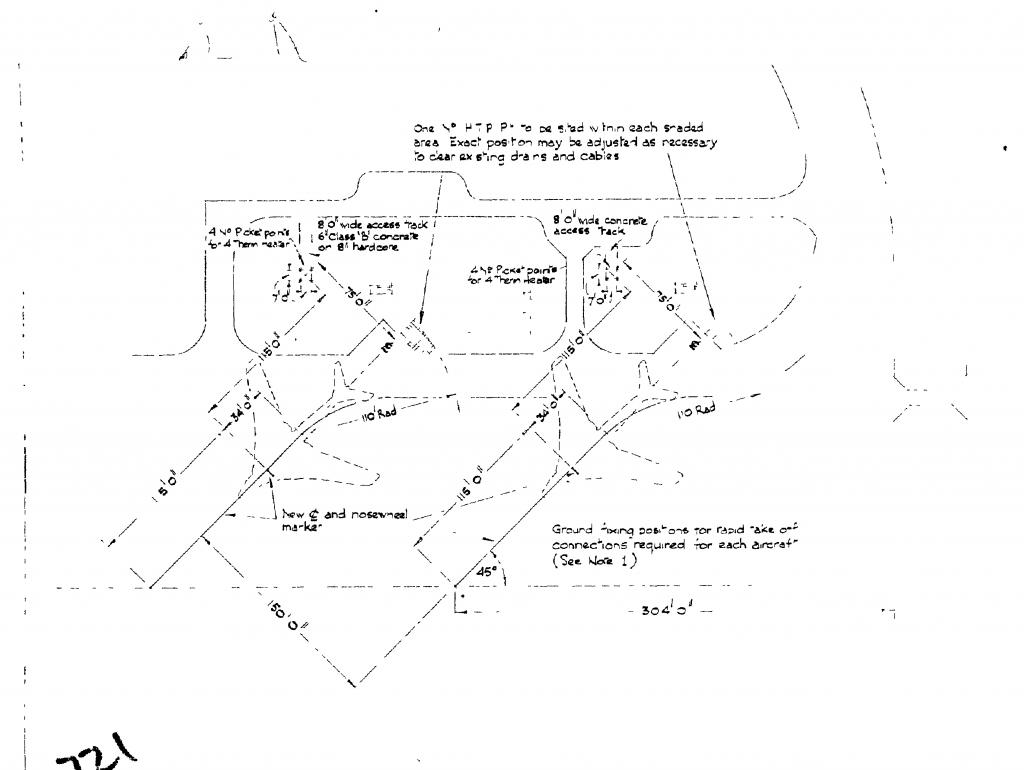
Not sure if you can make this drawing out as it auto resizes and the original is very poor anyway. But Stevo's drawing of Coltishall is close but the position of the Vulcans is not correct - the wing tips are too close to the ground equipment and the aircraft centre-line should be aligned on the centre-line of the triangular fillet. This 1965 drawing shows Victors but we have others showing Vulcans drawn on Colts ORP. The small hardstanding to the NE of the ORP was for a fire truck everything else on Stevo's drawing is correct. It also shows the positions of the HTP dumps, that I spoke about earlier.
Attached files
This image is hidden for guests.
Attached files
This image is hidden for guests.
Please log in or register to see it.
You can tell a builder from an archaeologist by the size of his trowel. Mine is a small one!
Please Log in or Create an account to join the conversation.
- ted angus
- Offline
- Platinum Member
-
Less
More
- Posts: 1643
- Thank you received: 51
25 Aug 2013 09:47 #58
by ted angus
You may well be right But Always had in the grey cells No 2 ;I thought No 1 was further back possibly near the clutch stations and the channel port rail link near Moenchengladbach ?? blimey its a few years now !
Replied by ted angus on topic RAF V-Bomber Bases in the UK
Are you sure it was no 2 war hospital Ted? AFAIK Gutersloh got no 1 war hospital, or that's what we had on LIONHEART in 84.
You may well be right But Always had in the grey cells No 2 ;I thought No 1 was further back possibly near the clutch stations and the channel port rail link near Moenchengladbach ?? blimey its a few years now !
Please Log in or Create an account to join the conversation.
- canberra
- Offline
- Platinum Member
-
Less
More
- Posts: 5639
- Thank you received: 122
25 Aug 2013 12:42 #59
by canberra
Replied by canberra on topic RAF V-Bomber Bases in the UK
And on the subject of ORPs for V bombers, Leuchars ORPs were/are 200 feet wide and 800 feet long. When I first got there the ones by the 27 threshold had caravans parked by them for the crews.
Please Log in or Create an account to join the conversation.
- canberra
- Offline
- Platinum Member
-
Less
More
- Posts: 5639
- Thank you received: 122
25 Aug 2013 16:35 #60
by canberra
Replied by canberra on topic RAF V-Bomber Bases in the UK
Ive seen the picture of Cranwell and now Im confused! What the pictures show as ORPs is what I knew as "the medium bomber dispersal", to me the ORPs are on the south side of the runway thresholds. Can anyone enlighten me?
Please Log in or Create an account to join the conversation.
- Forum
- Open Forum
- Miscellaneous Research Topics
- General Airfield or 20th Century Military Architecture Discussion Topics
- RAF V-Bomber Bases in the UK
Time to create page: 0.067 seconds